Your brand ranks on the first page of Google. You have good reviews, a fast site, and solid keyword coverage. So why does ChatGPT recommend three of your competitors when someone asks which tool to use?
This is the gap that AI search visibility describes. And for marketing teams, ecommerce brands, and SaaS companies, it is becoming one of the most consequential gaps in their entire go-to-market strategy.
When buyers ask AI for a recommendation, only a handful of brands appear in the answer. AI search visibility measures whether yours is one of them.
What AI Search Visibility Actually Means
AI search visibility is the degree to which your brand is cited, surfaced, or recommended inside AI-generated responses. Not where your URL sits in a list of ten blue links. Inside the answer itself.
When someone asks ChatGPT to recommend a project management tool, or asks Perplexity to compare email marketing platforms, or asks Google's AI Overview to explain which accounting software is best for freelancers, only a handful of brands appear. AI search visibility is a measure of whether yours is one of them, how often, and what the model says when it does mention you.
A fuller working definition: AI search visibility is the frequency, accuracy, and sentiment with which AI assistants, including ChatGPT, Claude, Perplexity, Google Gemini, Google AI Overviews, and others, mention, recommend, or cite a brand in response to user queries. Those three dimensions, frequency, accuracy, and sentiment, are each distinct. A brand can appear often but be described incorrectly. It can be cited positively on some platforms and negatively on others. It can appear in one engine's answers and be invisible on every other. Each of those is a different problem requiring a different fix.
Five metrics give this definition practical shape: mention rate, the position of the mention within the answer, sentiment, share of voice relative to competitors, and citation rate across tracked prompts. Together they tell you not just whether you showed up, but how you showed up and how that compares to the brands competing for the same buyer.
How It Differs From Traditional SEO
The confusion here is understandable. Both involve search. Both involve content. Both are influenced by the quality of your pages and the authority of your site. But they measure fundamentally different things.
Traditional SEO optimizes a page to rank for a query. The output is a URL's position in a paginated results list. AI search visibility concerns whether an entity, your brand as a whole, is selected and represented inside a synthesized answer. There is no page two in a ChatGPT response. There is no position five. There is the answer, and there are the two or three sources it chose to cite or name.
This is why a brand can rank number one on Google and be entirely invisible to AI systems. The signals that earn a top Google ranking are meaningful inputs to AI retrieval, but they are not sufficient. AI platforms also weigh entity clarity, third-party corroboration, structured data, the coverage of your content across the full range of relevant prompts, and the consistency of what the wider web says about you. A page that Google rewards for keyword density may not satisfy the question an LLM is trying to answer.
AI visibility does not replace SEO. Strong technical SEO and quality content remain important inputs. But the object of measurement is different, and treating your Google ranking as a proxy for AI presence will leave a real gap in your strategy.
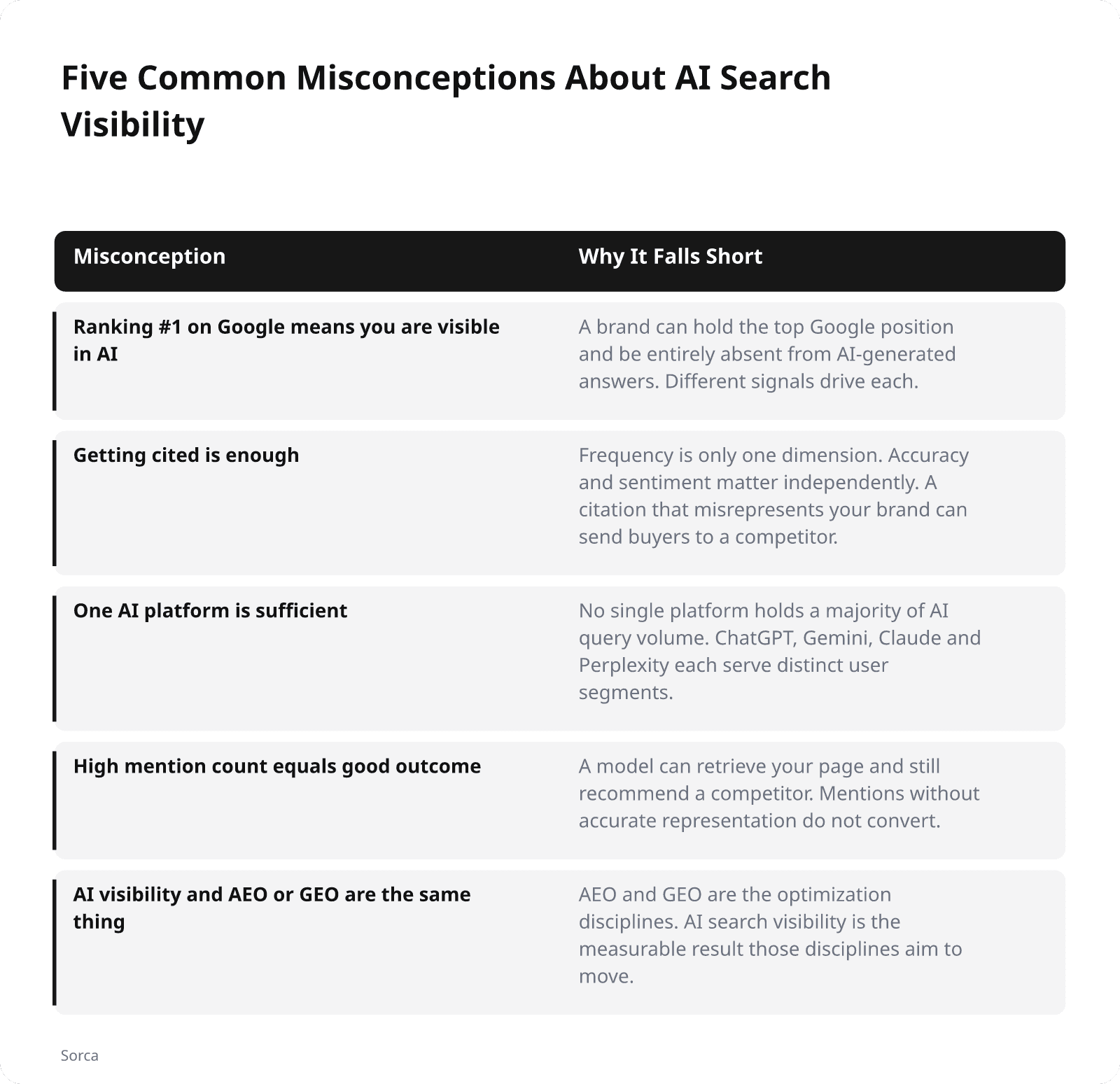
Each of these assumptions leads teams to measure the wrong thing or invest in the wrong fix.
Common Misconceptions Worth Clearing Up
A few assumptions come up repeatedly when teams start thinking about this area, and most of them are wrong in instructive ways.
The first is that citations are the whole story. They are not. A source can shape an answer without receiving a visit. A company can be mentioned without a link. A page can receive a citation but be represented inaccurately. A model can retrieve a page and still recommend a competitor. Each of these is a distinct failure mode, and frequency alone does not tell you which one you have.
The second is that one platform is enough. The AI search landscape is genuinely fragmented. By worldwide web-visit share in September 2026, ChatGPT held 57.5 percent, Google Gemini 25.7 percent, Claude 9.8 percent, DeepSeek 3.5 percent, Grok 2.0 percent, Perplexity 0.9 percent, and Microsoft Copilot 0.6 percent. Those numbers shift month to month and vary significantly depending on whether you measure by web visits, app downloads, or query volume. The consistent finding across all methodologies is fragmentation and rapid change. Optimizing only for ChatGPT means being invisible to a substantial share of AI users, and that share is growing.
The third misconception is subtler: that AI search visibility is the same thing as AEO or GEO. It is not. AEO (answer engine optimization) and GEO (generative engine optimization) are the disciplines and tactics used to improve your presence. AI search visibility is the measurable result those disciplines aim to move. The distinction matters because you need to measure the outcome separately from the activity, just as you would track organic traffic separately from the SEO work that drives it.
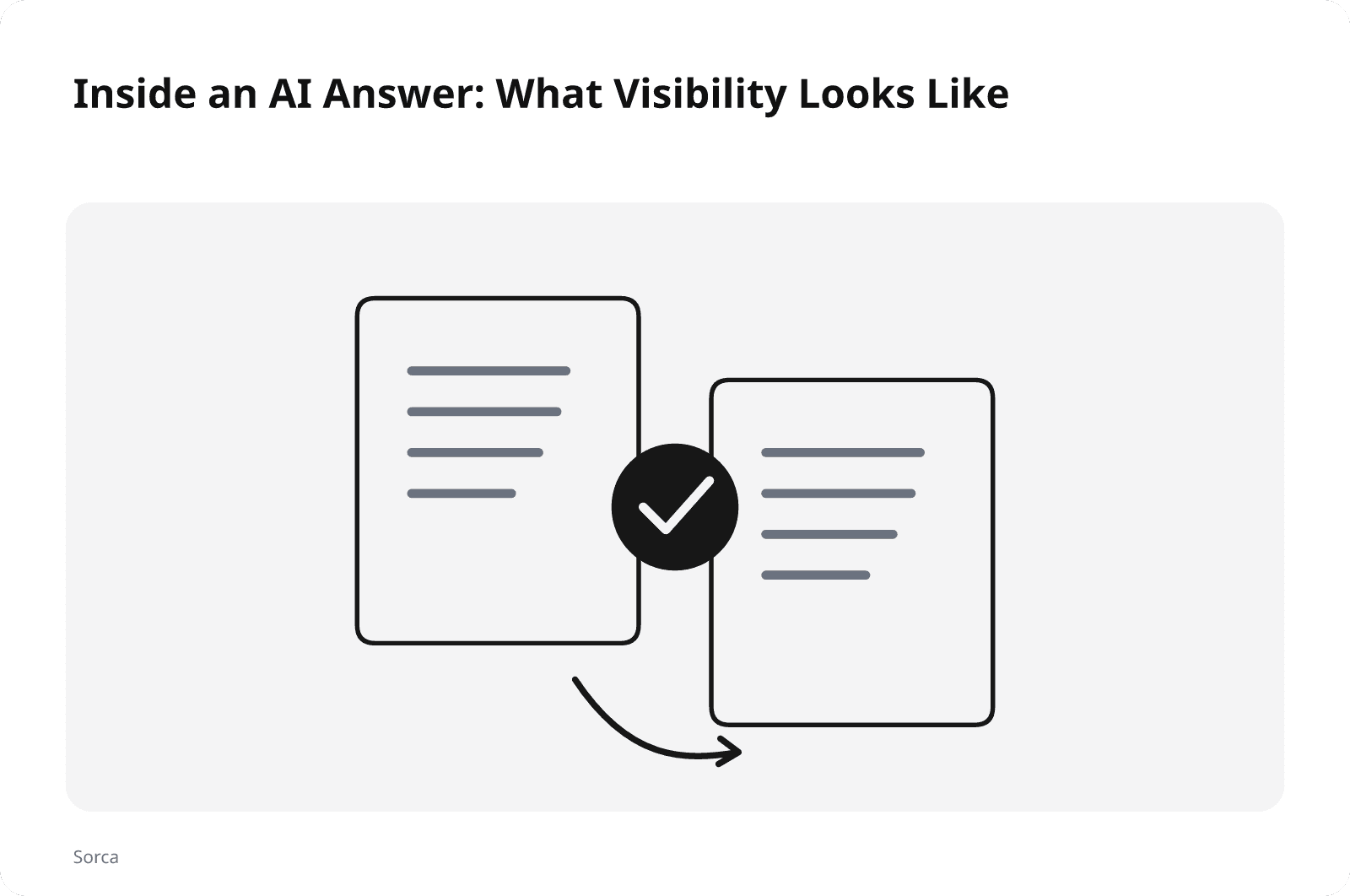
AI systems synthesize a response from multiple retrieved sources. Only the brands selected for that response have visibility on that prompt.
When AI Search Visibility Matters Most
For ecommerce and SaaS teams, the highest-stakes moment is the decision prompt. Users are no longer only browsing traditional search results. They ask AI tools for direct answers, product comparisons, recommendations, and summaries before they visit any website. If your brand does not appear in that answer, you lose the consideration before the buyer ever arrives. That is not a traffic problem. It is a pipeline problem.
For agencies, the business case is the gap between where a client ranks on Google and where they appear in AI answers. That gap is often surprising, and surfacing it is increasingly the starting point for a productive client conversation. Which prompts do buyers actually ask? Which competitors appear when they do? What does the model say about your client's brand versus the alternatives? These are answerable questions once you are tracking the right signals.
The dynamic underlying both cases is a winner-takes-most effect. AI systems typically name three to five brands per answer. They do not surface ten options and let the user decide. A brand that consistently appears in those answers is compounding awareness at scale. A brand that does not is invisible during the moments that shape purchase decisions, regardless of how well its website converts once someone eventually lands there.
This is also why the accuracy dimension matters so much. An AI system that mentions your brand but describes it incorrectly, attributes the wrong use case, quotes an outdated price, or frames you as a tool for a market you left two years ago, is not helping you. In some cases it is actively sending buyers to a competitor who fits the description better. Frequency without accuracy is not a win.
What a Practical Measurement Framework Looks Like
A useful model for thinking about AI search visibility has four layers, each with a distinct question attached.
Eligibility asks whether the platform can crawl and use your pages at all. If your site blocks AI crawlers, uses JavaScript rendering that leaves content invisible, or lacks the structured data that helps models resolve your entity, you may be failing before the competition even starts. This is the domain of technical optimization: correct schema, crawl paths, and AI-readable metadata.
Retrieval asks whether your content is selected as relevant evidence when a prompt is answered. This is where topic authority matters. AI platforms favor sources that cover a topic comprehensively and consistently, not pages that target isolated keywords. If your coverage of a topic is shallow or incomplete compared to a competitor's, retrieval will favor them.
Representation asks whether the answer cites, links, mentions, or summarizes your brand correctly. This is where third-party corroboration becomes critical. Models draw on what the broader web says about you: reviews, forum mentions, press coverage, directory listings, and community discussions. A brand that exists only on its own website is harder for a model to represent confidently than a brand with consistent, accurate mentions across sources it already trusts.
Outcome is the layer most teams care about immediately but cannot reach without the first three. It is the question of whether appearing in an answer translates to visits, consideration, and conversion. You cannot optimize outcomes directly. You can only improve eligibility, retrieval, and representation, and then measure what follows.
Tracking these layers on a consistent basis, across the specific prompts your buyers use, across the engines they use to ask them, and against the competitors appearing in the same answers, is what converts AI search visibility from a concept into something you can actually act on.

Each layer builds on the one before. You cannot optimize outcomes without first addressing eligibility, retrieval, and representation.
Where to Go From Here
If you are trying to understand where your brand currently stands in AI search, the starting point is an audit of what AI systems are actually saying about you. Not a theoretical analysis of your content, but a prompt-level view of where you appear, where you are absent, what the models say when they do mention you, and which competitors are filling the gaps.
From there, the work typically falls into four areas: technical access so models can read your site, topic coverage so your content answers the prompts that matter, citation building so third-party sources corroborate what your own pages say, and ongoing measurement so you can tell what is moving and what is not.
For a deeper look at the disciplines involved, the articles on what AEO is and how it works, what GEO means and how it differs from AEO, and why entity optimization is now foundational are useful next steps. If you want to see where your brand stands right now, Sorca's AEO Audit maps exactly that: where AI mentions you, where it skips you, and what it says when it does.