Most marketing teams think about SEO in terms of pages and keywords. You write content targeting a phrase, build links to that page, and track where it ranks. That model still works for a portion of search traffic, but it leaves a growing gap: AI systems do not answer questions by retrieving your best-ranking page. They answer by retrieving facts and attributing them to entities they already recognize.
If your brand is not established as a clear, unambiguous entity in the systems those AI models consult, your content may be excellent and still get skipped entirely. Entity optimization is the discipline that closes that gap.

How structured knowledge signals determine which brands AI systems recognize, cite, and recommend.
What an Entity Actually Is
Google's 2012 "Things, not strings" shift introduced a foundational change to how search works. Rather than matching the characters in a query against the characters on a page, Google began building a structured database of real-world things and the relationships between them. That database is the Knowledge Graph.
An entity is any distinct, identifiable thing: a person, an organization, a product, a place, an event, or a concept. Each entity in the Knowledge Graph holds a unique internal identifier, a set of typed properties (name, category, founding date, industry), and relationship edges to other entities. A software company, its founder, and the product category it operates in are all separate entities with documented connections.
Entity optimization is the practice of ensuring that your brand, your products, your key people, and your content are represented as clear, well-connected entities in these knowledge systems, rather than as anonymous text appearing on a webpage.
The practical consequence is significant. Google's Gemini AI is trained on the Knowledge Graph. ChatGPT, Perplexity, and other large language models consume web data that is heavily shaped by which sources those models can confidently attribute to a recognized real-world organization. When none of those systems can resolve your brand to a distinct entity, you become invisible to AI-generated answers even when your content is the most thorough available.
The Five Signals That Build Entity Clarity
Entity optimization is not a single action. It is a layered set of signals that, together, raise a system's confidence that your brand is a real, distinguishable organization with a defined area of expertise.
The entity home. This is usually an About page or a dedicated brand page carrying a JSON-LD block with an @id value that serves as your brand's permanent machine-readable identifier. When Google's systems encounter your brand name anywhere on the web, they follow the @id chain back to this page to confirm which organization they are dealing with. Without a stable @id, your brand name is just a string.
sameAs declarations. The sameAs property in schema.org structured data is the connective tissue of entity optimization. It points from your entity home outward to external records that describe the same organization: your Wikidata entry, your LinkedIn company page, your Crunchbase profile. Each corroborating source increases the system's confidence that multiple web records all describe one real organization.
A Wikidata entry. Unlike Wikipedia, Wikidata has no notability threshold. Any legitimate organization can create a structured entry and receive a unique QID identifier. That QID gives search engines and AI systems an unambiguous, stable reference point that persists regardless of what happens to any individual webpage. Creating a Wikidata entry with accurate properties and your official URL is one of the highest-return actions available for entity establishment.
Consistent brand signals across the web. If your organization's name appears in several different forms across directories, review platforms, and press coverage, the systems trying to resolve your entity face conflicting data. Consistency in your exact brand name, location details, and category descriptions across third-party sources reinforces the disambiguation work you have already done in your own structured data.
Entity salience in content. Search systems evaluate not just whether your brand appears on a page but how centrally it figures in that page's meaning. Pages where your brand is the clear subject, with rich surrounding context about what it does and who it serves, build stronger entity associations than pages where the brand name appears only incidentally.

Each layer reinforces the previous. The first three can be implemented at almost no cost and begin compounding immediately across both traditional and AI search.
Common Misconceptions Worth Clearing Up
The subject attracts a few persistent myths that lead teams to either over-invest in the wrong places or dismiss the work as irrelevant to them.
"We need a Wikipedia article first." Wikipedia is one data source Google uses, but it is far from the only one, and it carries genuine notability requirements that exclude most businesses. Wikidata is the more practical starting point: open to any legitimate organization, machine-readable by design, and directly consumed by the Knowledge Graph. Getting your brand into Wikidata with accurate structured properties is more actionable than pursuing a Wikipedia article and often more useful for entity resolution.
"Adding schema markup is enough." Structured data is a declaration, not a certificate. A JSON-LD block claiming that your organization is a leading authority in a given category carries no weight if the page's actual content provides no evidence for that claim. The structured data and the surrounding content must agree. When they do not, systems learn to discount both.
"This is an enterprise concern." Entity establishment matters more for smaller and newer brands, not less. A large brand with years of press coverage and a Wikipedia article probably already exists in the Knowledge Graph in some form. A growing SaaS company or an ecommerce brand launching in a competitive category may have no entity record at all, which means AI systems have no reliable anchor to attribute any of their content or expertise to a real organization.
"Entity optimization is a one-time project." The structured data implementation may be completed in a sprint, but entity authority builds over time as corroborating signals accumulate from third-party sources. Knowledge Panel changes and Knowledge Graph updates operate on their own schedules, and it is realistic to expect months rather than days before major changes fully reflect in AI-generated outputs.
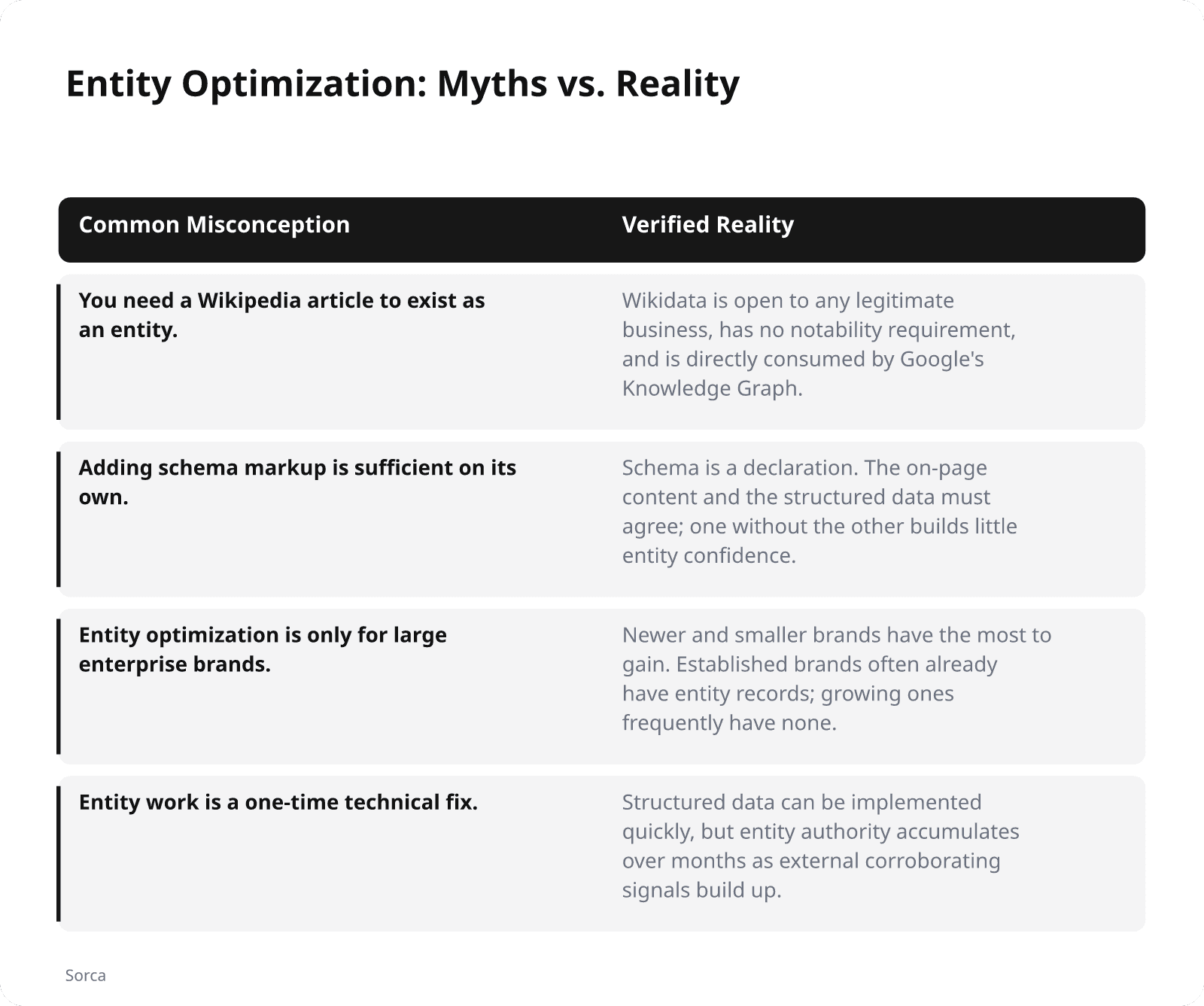
These misconceptions consistently lead marketing teams to delay or misdirect their entity work. The corrected framing is drawn from practitioner consensus across multiple sources.
How Entity Optimization Connects to AI Search Citations
The practical link between entity work and AI visibility runs through a specific chain. When Google indexes your content, it uses entity recognition to associate claims in that content with known entities. When Gemini composes an AI Overview answer, it draws on knowledge anchored to those entity records. When ChatGPT or Perplexity cite a source, they preferentially cite sources they can attribute to a recognized, trustworthy organization.
One analysis of AI Overview citation patterns found that brand mentions correlated with AI citation visibility at a considerably higher rate than backlinks alone, though both signals compound rather than substitute for each other. Link authority remains important because the vast majority of AI Overview citations come from pages that already rank on the first page of organic results. Entity authority then determines which of those ranking pages get cited by name. The two work together: link authority earns the position, entity authority earns the attribution.
This is also why citation building, the practice of earning your brand mentions across the third-party sources AI systems trust, is directly intertwined with entity work. When a trusted industry publication, a relevant forum thread, or a review platform mentions your brand consistently and accurately, those mentions reinforce your entity record from outside your own site. Sorca's citation building service targets exactly these corroborating sources, from industry press to review platforms, because the value of each mention extends beyond referral traffic to entity reinforcement.
Where to Start: A Practical Priority Order
For most brands the practical sequencing is straightforward, even if the execution takes time.
Begin with the entity home. Create or update an About page with complete Organization schema, a stable @id pointing to your canonical domain, and a clear prose description of what your organization does and who it serves.
Then create or claim your Wikidata entry. Add accurate properties: organization type, founding date, industry, official website. Keep it factual and verifiable.
Next, add sameAs values to your entity home schema, pointing to your Wikidata QID, your LinkedIn company page, and any other authoritative third-party profiles that describe your organization.
With those foundations in place, review your key content pages for entity salience. Pages covering your core topics should mention your brand as the clear subject in contextually rich ways, not just as a tag or a byline.
Finally, build the external corroboration: press mentions, industry directory listings, review platform profiles, and community contributions that consistently use your exact brand name and describe your category accurately. Each of these reinforces the entity record you have built in structured data.
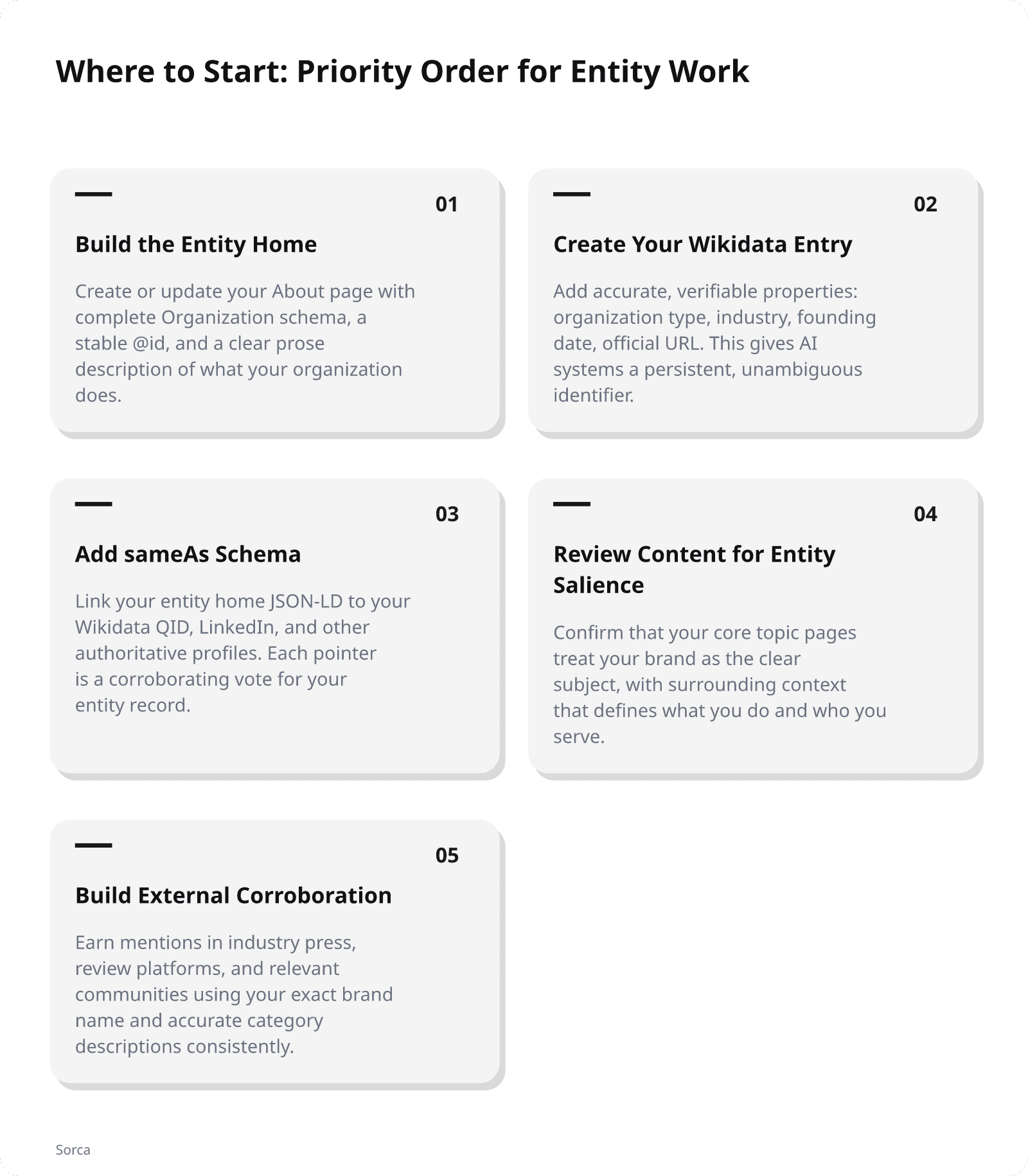
Follow this sequence before investing in citation campaigns or content programs. Each step creates the foundation the next one depends on.
Entity Optimization and Technical Readability
Entity signals work only if AI crawlers can actually read your pages. A correctly structured schema graph sitting behind a JavaScript-rendered page that crawlers see as empty is effectively invisible. The technical foundations, allowing AI crawlers access, ensuring server-side rendering for critical content, and connecting your schema blocks into a coherent @graph rather than isolated fragments, are prerequisites, not optional extras.
This is why a technical audit is the natural starting point for brands serious about entity optimization. Before investing in Wikidata entries and citation campaigns, it is worth confirming that your existing structured data is valid, your entity home is crawlable, and your @id values are consistent across every page that references your organization.
Conclusion
Entity optimization is the unglamorous infrastructure underneath AI search visibility. It does not generate immediate traffic reports or dramatic ranking changes. What it does is create the conditions under which everything else you publish, every citation you earn, and every piece of content you produce can be attributed to your brand with confidence by the systems that now answer a large and growing share of the questions your customers are asking.
The work is not complex, but it is specific: a stable entity home, a Wikidata entry, coherent sameAs schema, consistent brand signals, and external corroboration from sources the systems trust. Done in that order, these steps form a durable foundation that compounds in value as AI search continues to grow.
If you are unsure where your brand currently stands, an AEO audit is the clearest starting point. It maps where AI systems currently recognize or misattribute your brand and produces a prioritized list of what to fix first.