If your brand ranks well on Google but barely appears in ChatGPT or Perplexity answers, the problem probably isn't your domain authority. It might actually be because of it — or rather, because you've spent years optimising for a signal that AI answer engines largely ignore.
This is one of the most disorienting shifts in search right now. The metric that SEO teams have used as a proxy for credibility for over a decade turns out to be a poor predictor of how often a brand gets cited by an LLM. Understanding why requires understanding how AI models actually assess expertise, and what they're looking for instead.

AI answer engines assess credibility through content depth and cluster architecture, not domain-level link metrics.
What Domain Authority Measures (and What It Misses)
Domain authority is a third-party metric designed to approximate how well a domain will rank on Google. It aggregates link signals: the number of backlinks pointing to a site, the authority of the linking domains, and anchor text patterns. It is a useful proxy for traditional ranking potential, and it correlates reasonably well with organic visibility across competitive keyword landscapes.
The trouble is that large language models don't rank pages. They generate answers. And the process they use to decide which sources to draw from, reference, or cite is structurally different from how a search crawler evaluates a backlink graph.
One analysis of hundreds of thousands of pages across thousands of queries found that domain authority shows no positive correlation with AI citation probability — and is, if anything, slightly inversely correlated. A high DA score on a site that covers a topic shallowly doesn't signal trustworthiness to an LLM. It signals scale, not expertise.
How AI Models Actually Assess Credibility
LLMs don't read your site the way a user does. They build an internal representation of entities, topics, and relationships during training, then retrieve and synthesise from that representation (or from live retrieval, in the case of tools like Perplexity or ChatGPT Browse). The signals that shape those representations are different from the ones that move your Google rankings.
Three mechanisms matter most.
Entity consistency across platforms. An LLM develops a richer, more confident model of your brand when it encounters consistent signals about what you do, who you serve, and what you're expert in across multiple independent sources. Wikipedia entries, LinkedIn profiles, press mentions, industry directories, podcast appearances and forum citations all contribute. Inconsistency across these surfaces weakens the model's confidence in your entity. Clarity strengthens it.
Content depth and cluster coverage. LLMs evaluate the entire ecosystem of content around a topic, not just the single page closest to a query. A site that has a comprehensive pillar page, a set of well-linked supporting articles covering each important angle, a comparison section, an FAQ layer and relevant case examples sends a much stronger authority signal than a site with one excellent article and nothing around it. The model treats the breadth and interconnectedness of coverage as evidence of genuine expertise.
Semantic coherence rather than keyword density. Models are not scanning for how many times you've used a target phrase. They are assessing whether your content demonstrates actual understanding: appropriate use of industry terminology, nuanced treatment of edge cases, and the kind of connected reasoning that reflects real expertise. Comprehensive coverage of a subject reads very differently to a page optimised around a keyword.

Three mechanisms shape whether an AI model treats a brand as a credible source on a topic.
These mechanisms explain a pattern that's increasingly visible in practice. Companies that define a precise domain of expertise and build complete, interconnected content around it get cited. Companies that remain broad and generic get passed over, regardless of their content quality at the individual page level or their domain authority score.
What Genuine Topic Authority Requires
Building topic authority for AI search is not a matter of writing more content. It is a matter of building a content architecture that signals complete mastery of a specific subject.
The starting point is prompt mapping: understanding the actual questions your buyers are asking across the full research journey, not just the head terms you'd target for Google. Buyers exploring a category ask conceptual questions early, then comparative questions, then specific implementation questions. A topic authority strategy maps content to every meaningful stage of that journey.
From that map, you build a cluster. A pillar page covers the subject comprehensively at the top level. Supporting pages go deep on each important angle: definitions, comparisons, use cases, technical considerations, common mistakes, advanced applications. These pages connect to each other through internal links that make the relationships between concepts explicit and navigable, both for users and for AI retrieval systems.
The architecture matters as much as the content itself. An AI retrieval system that encounters five related pages with consistent entity signals and clear linking relationships reads that as coherent topical authority. A single well-written page on the same subject, with nothing around it, sends a much weaker signal regardless of how good that page is.
Entity accuracy matters throughout. That means your brand description, your product definitions, your claims about what you do and who you serve need to be consistent across page types: not just coherent in your blog content, but aligned with your service pages, your about section, and everything else a model might encounter. Analytical depth in one corner of a site doesn't compensate for vague marketing language elsewhere.
Content freshness is the third requirement, and it's the one that trips up the most teams. Retrieval-augmented systems prioritise sources that signal temporal relevance. The important nuance here is that updating a publication date without changing the underlying content has minimal effect on LLM citations. Substantive content changes are what move the signal. Topics that evolve quickly need real content updates on a regular schedule, not cosmetic timestamp edits.
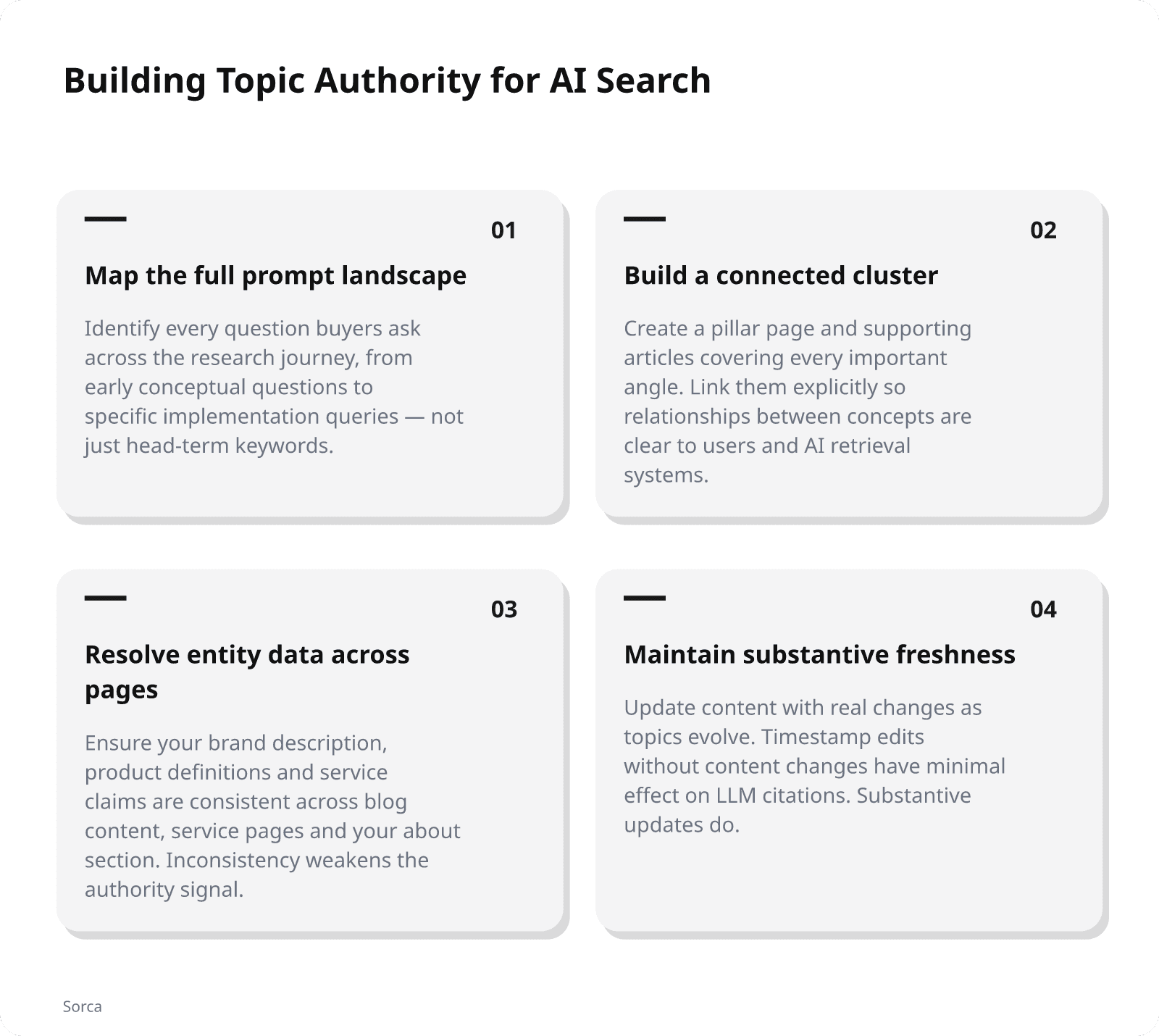
Four operational steps that move a brand from surface-level coverage to genuine AI-cited authority.
Why Thin or Scattered Coverage Gets Passed Over
It's worth being specific about what fails, because the failure modes are not always obvious.
A site that ranks for a competitive head term on Google but has no supporting content around it looks thin to an AI model. The head term page may be excellent, but the absence of surrounding content means the model has no evidence of deeper expertise. It may reference the page, but it is unlikely to treat the brand as a reliable authority on the subject.
A site that has a lot of content but covers too many unrelated topics sends a similarly weak signal. Breadth without focus looks like a content farm, not a specialist. LLMs favour sources that have a recognisable topical centre of gravity.
Duplicate ideas spread across multiple posts dilute rather than reinforce authority. If five articles say more or less the same thing in slightly different words, an LLM doesn't read that as five data points supporting one claim. It reads it as one claim with a lot of repetition. Genuine authority comes from adding new angles, not recycling existing ones.
Citation concentration in AI search is real and significant. The sources that appear consistently in LLM answers for a given topic tend to be the same small set of domains that have established deep, consistent coverage. Getting into that set requires building a content ecosystem that is recognisably authoritative from the model's perspective, not just from a keyword ranking perspective.
Comparing Topic Authority Approaches
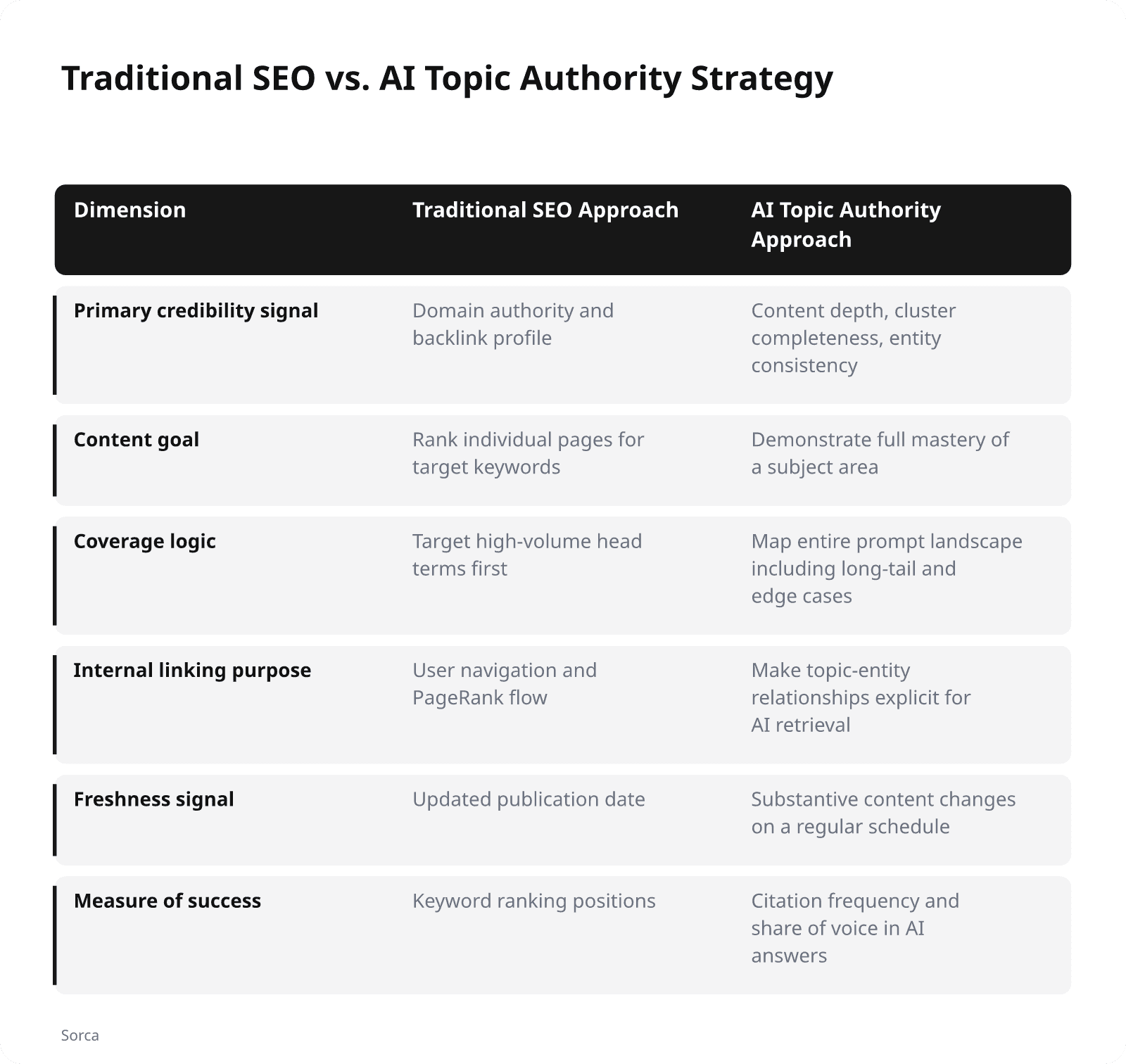
The underlying writing quality standard is similar. The architecture, coverage logic and signals being optimised are different.
The table above captures the practical difference between how traditional SEO and AI-optimised content strategy approach the same goal. The underlying writing standards are similar. The architecture, the coverage logic, and the signals being optimised are not.
For teams accustomed to thinking in terms of keyword targets and domain metrics, the reorientation is meaningful. The question shifts from "which pages can I rank?" to "does my content architecture demonstrate that I own this subject?"
Putting It Into Practice
Building topic authority for AI search is a compound investment. It typically requires mapping the full prompt landscape for your topic, auditing existing content against that map to identify gaps, building or restructuring cluster architecture around a pillar, resolving entity data for accuracy and consistency, and then maintaining content relevance through substantive updates as the subject evolves.
Early citations in AI answers can appear within weeks as models encounter fresh cluster content. Fuller authority, where a brand becomes a default reference on a topic across multiple engines, builds over one to two months as the signal accumulates.
Sorca's Topic Authority service handles this work directly: mapping the real prompts buyers ask, building cluster content that covers every important angle, connecting related pages so the expertise signal is clear, and maintaining accuracy as AI answers evolve. If you've invested in content and rankings but your brand is still absent from AI answers, the cluster structure is almost always where the gap is.
You can also read about how entity optimization and citation building work alongside topic authority to complete the picture. The three are closely connected: entities define what you are, citations confirm it from third parties, and topic authority demonstrates that you know your subject better than anyone else.